202
203
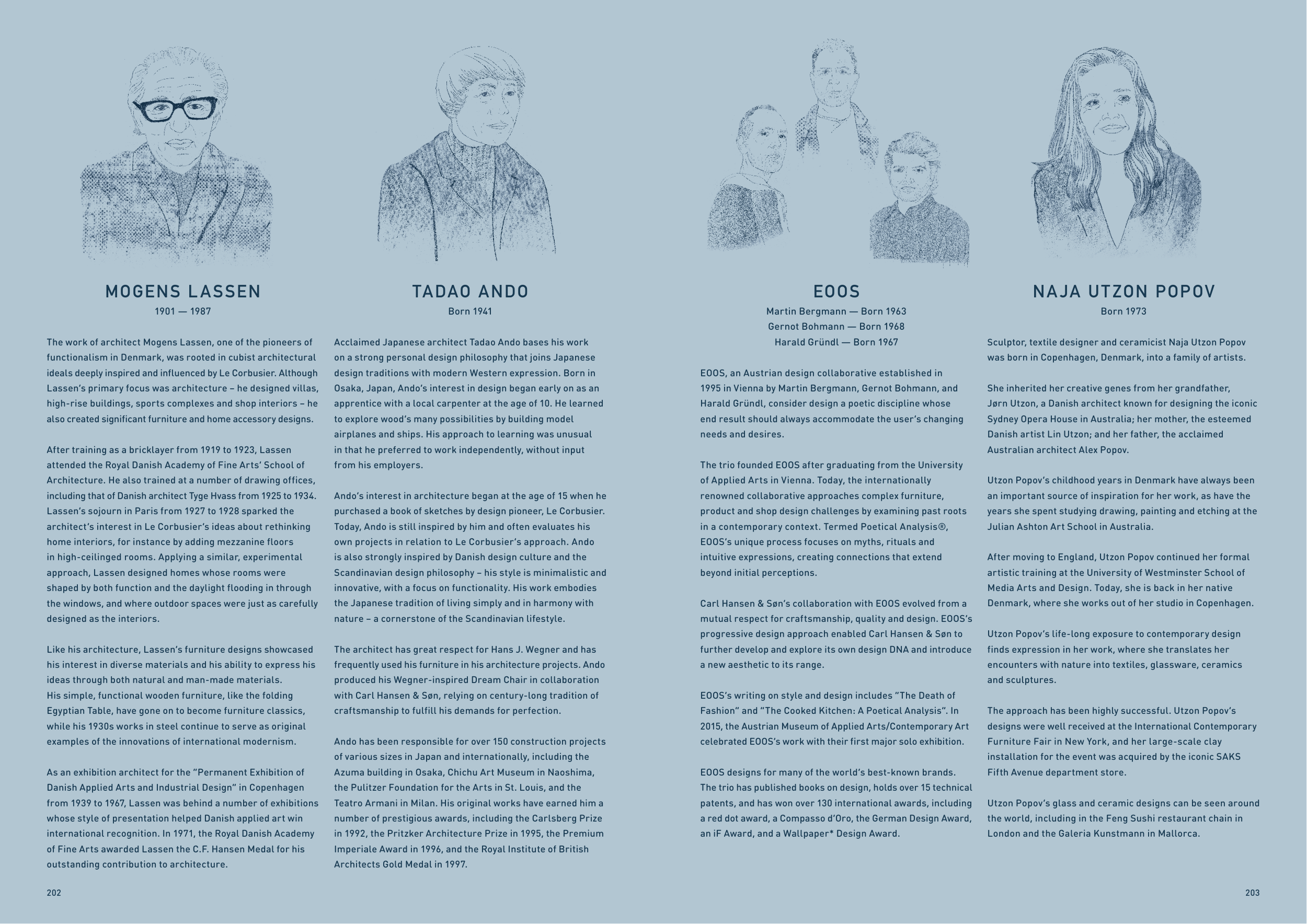
TADAO ANDO
Born 1941
MOGENS LASSEN
1901 — 1987
EOOS
Martin Bergmann — Born 1963
Gernot Bohmann — Born 1968
Harald Gründl — Born 1967
NAJA UTZON POPOV
Born 1973
Acclaimed Japanese architect Tadao Ando bases his work
on a strong personal design philosophy that joins Japanese
design traditions with modern Western expression. Born in
Osaka, Japan, Ando’s interest in design began early on as an
apprentice with a local carpenter at the age of 10. He learned
to explore wood’s many possibilities by building model
airplanes and ships. His approach to learning was unusual
in that he preferred to work independently, without input
from his employers.
Ando’s interest in architecture began at the age of 15 when he
purchased a book of sketches by design pioneer, Le Corbusier.
Today, Ando is still inspired by him and often evaluates his
own projects in relation to Le Corbusier’s approach. Ando
is also strongly inspired by Danish design culture and the
Scandinavian design philosophy – his style is minimalistic and
innovative, with a focus on functionality. His work embodies
the Japanese tradition of living simply and in harmony with
nature – a cornerstone of the Scandinavian lifestyle.
The architect has great respect for Hans J. Wegner and has
frequently used his furniture in his architecture projects. Ando
produced his Wegner-inspired Dream Chair in collaboration
with Carl Hansen & Søn, relying on century-long tradition of
craftsmanship to fulfill his demands for perfection.
Ando has been responsible for over 150 construction projects
of various sizes in Japan and internationally, including the
Azuma building in Osaka, Chichu Art Museum in Naoshima,
the Pulitzer Foundation for the Arts in St. Louis, and the
Teatro Armani in Milan. His original works have earned him a
number of prestigious awards, including the Carlsberg Prize
in 1992, the Pritzker Architecture Prize in 1995, the Premium
Imperiale Award in 1996, and the Royal Institute of British
Architects Gold Medal in 1997.
The work of architect Mogens Lassen, one of the pioneers of
functionalism in Denmark, was rooted in cubist architectural
ideals deeply inspired and influenced by Le Corbusier. Although
Lassen’s primary focus was architecture – he designed villas,
high-rise buildings, sports complexes and shop interiors – he
also created significant furniture and home accessory designs.
After training as a bricklayer from 1919 to 1923, Lassen
attended the Royal Danish Academy of Fine Arts’ School of
Architecture. He also trained at a number of drawing offices,
including that of Danish architect Tyge Hvass from 1925 to 1934.
Lassen’s sojourn in Paris from 1927 to 1928 sparked the
architect’s interest in Le Corbusier’s ideas about rethinking
home interiors, for instance by adding mezzanine floors
in high-ceilinged rooms. Applying a similar, experimental
approach, Lassen designed homes whose rooms were
shaped by both function and the daylight flooding in through
the windows, and where outdoor spaces were just as carefully
designed as the interiors.
Like his architecture, Lassen’s furniture designs showcased
his interest in diverse materials and his ability to express his
ideas through both natural and man-made materials.
His simple, functional wooden furniture, like the folding
Egyptian Table, have gone on to become furniture classics,
while his 1930s works in steel continue to serve as original
examples of the innovations of international modernism.
As an exhibition architect for the “Permanent Exhibition of
Danish Applied Arts and Industrial Design” in Copenhagen
from 1939 to 1967, Lassen was behind a number of exhibitions
whose style of presentation helped Danish applied art win
international recognition. In 1971, the Royal Danish Academy
of Fine Arts awarded Lassen the C.F. Hansen Medal for his
outstanding contribution to architecture.
Sculptor, textile designer and ceramicist Naja Utzon Popov
was born in Copenhagen, Denmark, into a family of artists.
She inherited her creative genes from her grandfather,
Jørn Utzon, a Danish architect known for designing the iconic
Sydney Opera House in Australia; her mother, the esteemed
Danish artist Lin Utzon; and her father, the acclaimed
Australian architect Alex Popov.
Utzon Popov’s childhood years in Denmark have always been
an important source of inspiration for her work, as have the
years she spent studying drawing, painting and etching at the
Julian Ashton Art School in Australia.
After moving to England, Utzon Popov continued her formal
artistic training at the University of Westminster School of
Media Arts and Design. Today, she is back in her native
Denmark, where she works out of her studio in Copenhagen.
Utzon Popov’s life-long exposure to contemporary design
finds expression in her work, where she translates her
encounters with nature into textiles, glassware, ceramics
and sculptures.
The approach has been highly successful. Utzon Popov’s
designs were well received at the International Contemporary
Furniture Fair in New York, and her large-scale clay
installation for the event was acquired by the iconic SAKS
Fifth Avenue department store.
Utzon Popov’s glass and ceramic designs can be seen around
the world, including in the Feng Sushi restaurant chain in
London and the Galeria Kunstmann in Mallorca.
EOOS, an Austrian design collaborative established in
1995 in Vienna by Martin Bergmann, Gernot Bohmann, and
Harald Gründl, consider design a poetic discipline whose
end result should always accommodate the user’s changing
needs and desires.
The trio founded EOOS after graduating from the University
of Applied Arts in Vienna. Today, the internationally
renowned collaborative approaches complex furniture,
product and shop design challenges by examining past roots
in a contemporary context. Termed Poetical Analysis®,
EOOS’s unique process focuses on myths, rituals and
intuitive expressions, creating connections that extend
beyond initial perceptions.
Carl Hansen & Søn’s collaboration with EOOS evolved from a
mutual respect for craftsmanship, quality and design. EOOS’s
progressive design approach enabled Carl Hansen & Søn to
further develop and explore its own design DNA and introduce
a new aesthetic to its range.
EOOS’s writing on style and design includes “The Death of
Fashion” and “The Cooked Kitchen: A Poetical Analysis”. In
2015, the Austrian Museum of Applied Arts/Contemporary Art
celebrated EOOS’s work with their first major solo exhibition.
EOOS designs for many of the world’s best-known brands.
The trio has published books on design, holds over 15 technical
patents, and has won over 130 international awards, including
a red dot award, a Compasso d’Oro, the German Design Award,
an iF Award, and a Wallpaper* Design Award.