198
199
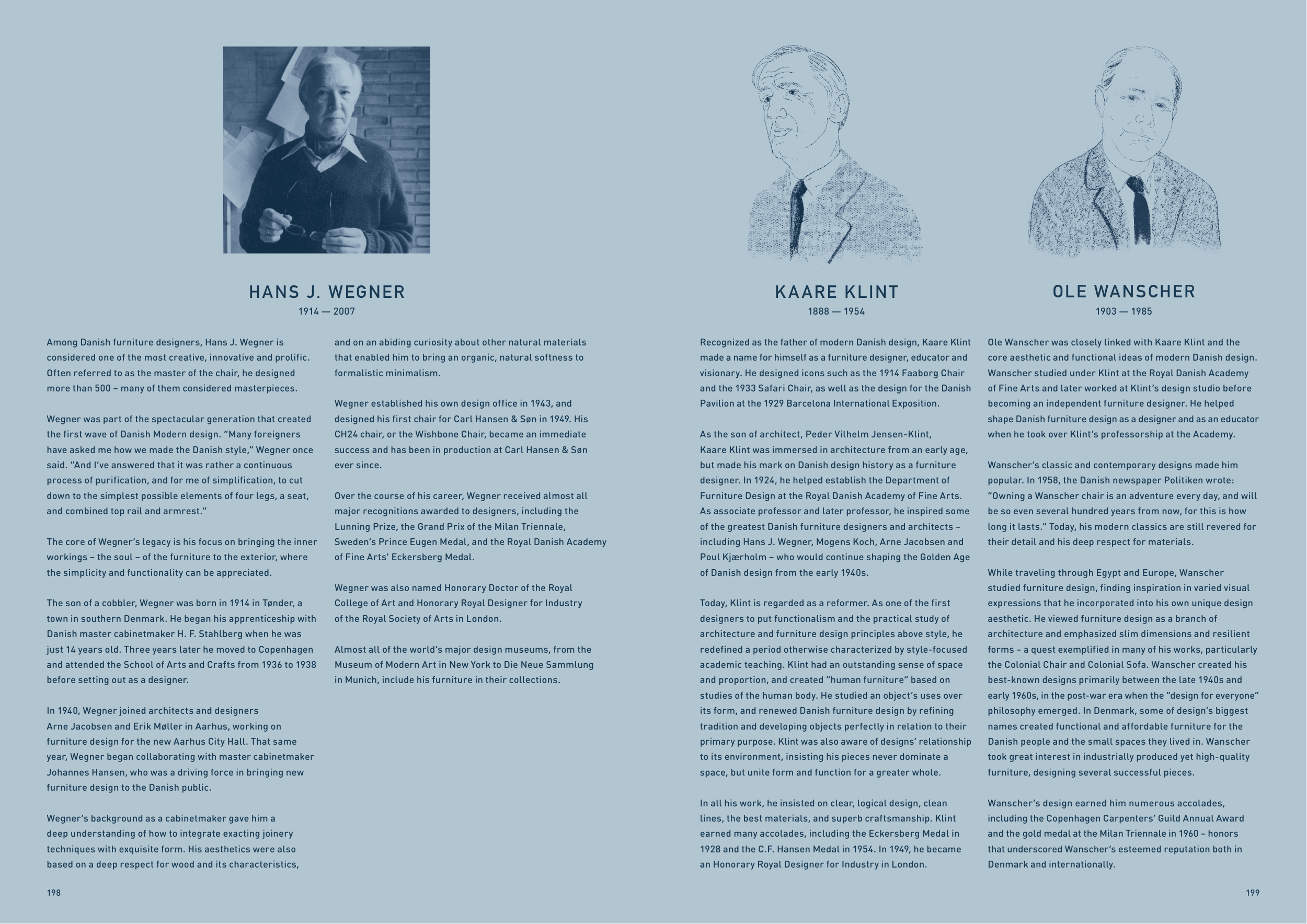
Among Danish furniture designers, Hans J. Wegner is
considered one of the most creative, innovative and prolific.
Often referred to as the master of the chair, he designed
more than 500 – many of them considered masterpieces.
Wegner was part of the spectacular generation that created
the first wave of Danish Modern design. “Many foreigners
have asked me how we made the Danish style,” Wegner once
said. “And I’ve answered that it was rather a continuous
process of purification, and for me of simplification, to cut
down to the simplest possible elements of four legs, a seat,
and combined top rail and armrest.”
The core of Wegner’s legacy is his focus on bringing the inner
workings – the soul – of the furniture to the exterior, where
the simplicity and functionality can be appreciated.
The son of a cobbler, Wegner was born in 1914 in Tønder, a
town in southern Denmark. He began his apprenticeship with
Danish master cabinetmaker H. F. Stahlberg when he was
just 14 years old. Three years later he moved to Copenhagen
and attended the School of Arts and Crafts from 1936 to 1938
before setting out as a designer.
In 1940, Wegner joined architects and designers
Arne Jacobsen and Erik Møller in Aarhus, working on
furniture design for the new Aarhus City Hall. That same
year, Wegner began collaborating with master cabinetmaker
Johannes Hansen, who was a driving force in bringing new
furniture design to the Danish public.
Wegner’s background as a cabinetmaker gave him a
deep understanding of how to integrate exacting joinery
techniques with exquisite form. His aesthetics were also
based on a deep respect for wood and its characteristics,
HANS J. WEGNER
1914 — 2007
and on an abiding curiosity about other natural materials
that enabled him to bring an organic, natural softness to
formalistic minimalism.
Wegner established his own design office in 1943, and
designed his first chair for Carl Hansen & Søn in 1949. His
CH24 chair, or the Wishbone Chair, became an immediate
success and has been in production at Carl Hansen & Søn
ever since.
Over the course of his career, Wegner received almost all
major recognitions awarded to designers, including the
Lunning Prize, the Grand Prix of the Milan Triennale,
Sweden’s Prince Eugen Medal, and the Royal Danish Academy
of Fine Arts’ Eckersberg Medal.
Wegner was also named Honorary Doctor of the Royal
College of Art and Honorary Royal Designer for Industry
of the Royal Society of Arts in London.
Almost all of the world’s major design museums, from the
Museum of Modern Art in New York to Die Neue Sammlung
in Munich, include his furniture in their collections.
KAARE KLINT
1888 — 1954
OLE WANSCHER
1903 — 1985
Recognized as the father of modern Danish design, Kaare Klint
made a name for himself as a furniture designer, educator and
visionary. He designed icons such as the 1914 Faaborg Chair
and the 1933 Safari Chair, as well as the design for the Danish
Pavilion at the 1929 Barcelona International Exposition.
As the son of architect, Peder Vilhelm Jensen-Klint,
Kaare Klint was immersed in architecture from an early age,
but made his mark on Danish design history as a furniture
designer. In 1924, he helped establish the Department of
Furniture Design at the Royal Danish Academy of Fine Arts.
As associate professor and later professor, he inspired some
of the greatest Danish furniture designers and architects –
including Hans J. Wegner, Mogens Koch, Arne Jacobsen and
Poul Kjærholm – who would continue shaping the Golden Age
of Danish design from the early 1940s.
Today, Klint is regarded as a reformer. As one of the first
designers to put functionalism and the practical study of
architecture and furniture design principles above style, he
redefined a period otherwise characterized by style-focused
academic teaching. Klint had an outstanding sense of space
and proportion, and created “human furniture” based on
studies of the human body. He studied an object’s uses over
its form, and renewed Danish furniture design by refining
tradition and developing objects perfectly in relation to their
primary purpose. Klint was also aware of designs’ relationship
to its environment, insisting his pieces never dominate a
space, but unite form and function for a greater whole.
In all his work, he insisted on clear, logical design, clean
lines, the best materials, and superb craftsmanship. Klint
earned many accolades, including the Eckersberg Medal in
1928 and the C.F. Hansen Medal in 1954. In 1949, he became
an Honorary Royal Designer for Industry in London.
Ole Wanscher was closely linked with Kaare Klint and the
core aesthetic and functional ideas of modern Danish design.
Wanscher studied under Klint at the Royal Danish Academy
of Fine Arts and later worked at Klint’s design studio before
becoming an independent furniture designer. He helped
shape Danish furniture design as a designer and as an educator
when he took over Klint’s professorship at the Academy.
Wanscher’s classic and contemporary designs made him
popular. In 1958, the Danish newspaper Politiken wrote:
“Owning a Wanscher chair is an adventure every day, and will
be so even several hundred years from now, for this is how
long it lasts.” Today, his modern classics are still revered for
their detail and his deep respect for materials.
While traveling through Egypt and Europe, Wanscher
studied furniture design, finding inspiration in varied visual
expressions that he incorporated into his own unique design
aesthetic. He viewed furniture design as a branch of
architecture and emphasized slim dimensions and resilient
forms – a quest exemplified in many of his works, particularly
the Colonial Chair and Colonial Sofa. Wanscher created his
best-known designs primarily between the late 1940s and
early 1960s, in the post-war era when the “design for everyone”
philosophy emerged. In Denmark, some of design’s biggest
names created functional and affordable furniture for the
Danish people and the small spaces they lived in. Wanscher
took great interest in industrially produced yet high-quality
furniture, designing several successful pieces.
Wanscher’s design earned him numerous accolades,
including the Copenhagen Carpenters’ Guild Annual Award
and the gold medal at the Milan Triennale in 1960 – honors
that underscored Wanscher’s esteemed reputation both in
Denmark and internationally.