21
STING – Design “an entirely normal chair – made in an entirely new way”. Such was
the assignment Fredrik Mattson obtained during the Milan Furniture Fair in 2002. He was
then still attending Konstfack school of design. The project ultimately also involved one of
Fredrik’s classmates, Stefan Borselius, with whom he was developing an aluminium chair
that the two of them wanted us to see. We replied immediately, and without a second
thought, that we didn’t want an aluminium chair. But Fredrik insisted that we really ought
to see it before we turned it down, which made us instantly curious.
Six weeks later, over the course of a long PowerPoint presentation, we witnessed the
birth of a classic – a chair that would make us proud, both then and far into the future.
Although we did wonder whether it could really work. Stefan and Fredrik thought they had
everything worked out. But after our very frst factory visit, it became clear to us that what
we believed in was technically impossible. We had challenged a well-known industrial
process and applied its possibilities far beyond the limits of the process – on paper.
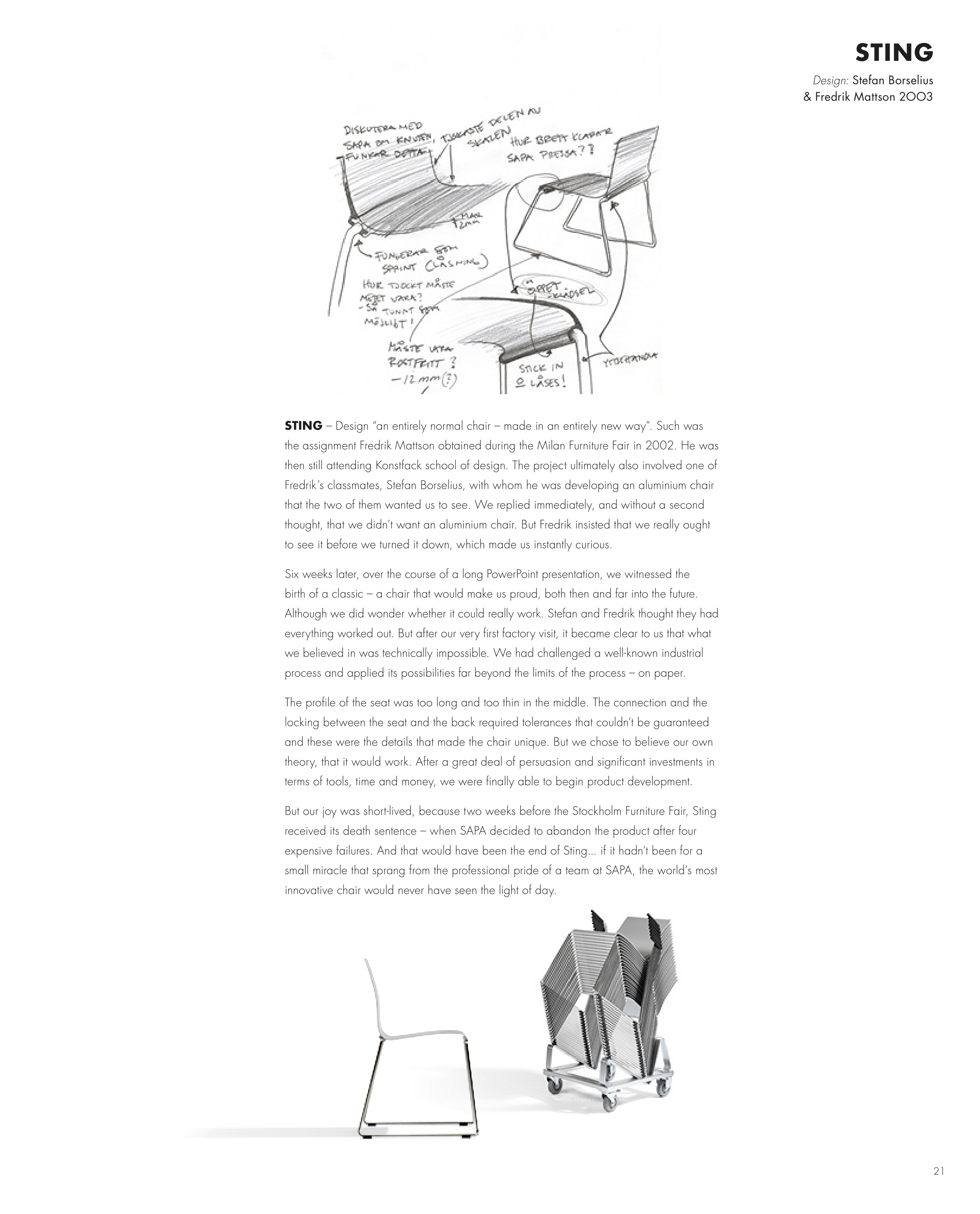
The profle of the seat was too long and too thin in the middle. The connection and the
locking between the seat and the back required tolerances that couldn’t be guaranteed
and these were the details that made the chair unique. But we chose to believe our own
theory, that it would work. After a great deal of persuasion and signifcant investments in
terms of tools, time and money, we were fnally able to begin product development.
But our joy was short-lived, because two weeks before the Stockholm Furniture Fair, Sting
received its death sentence – when SAPA decided to abandon the product after four
expensive failures. And that would have been the end of Sting... if it hadn’t been for a
small miracle that sprang from the professional pride of a team at SAPA, the world’s most
innovative chair would never have seen the light of day.
STING
Design: Stefan Borselius
& Fredrik Mattson 2OO3