10
TANGANICA
/ TANGANYIKA
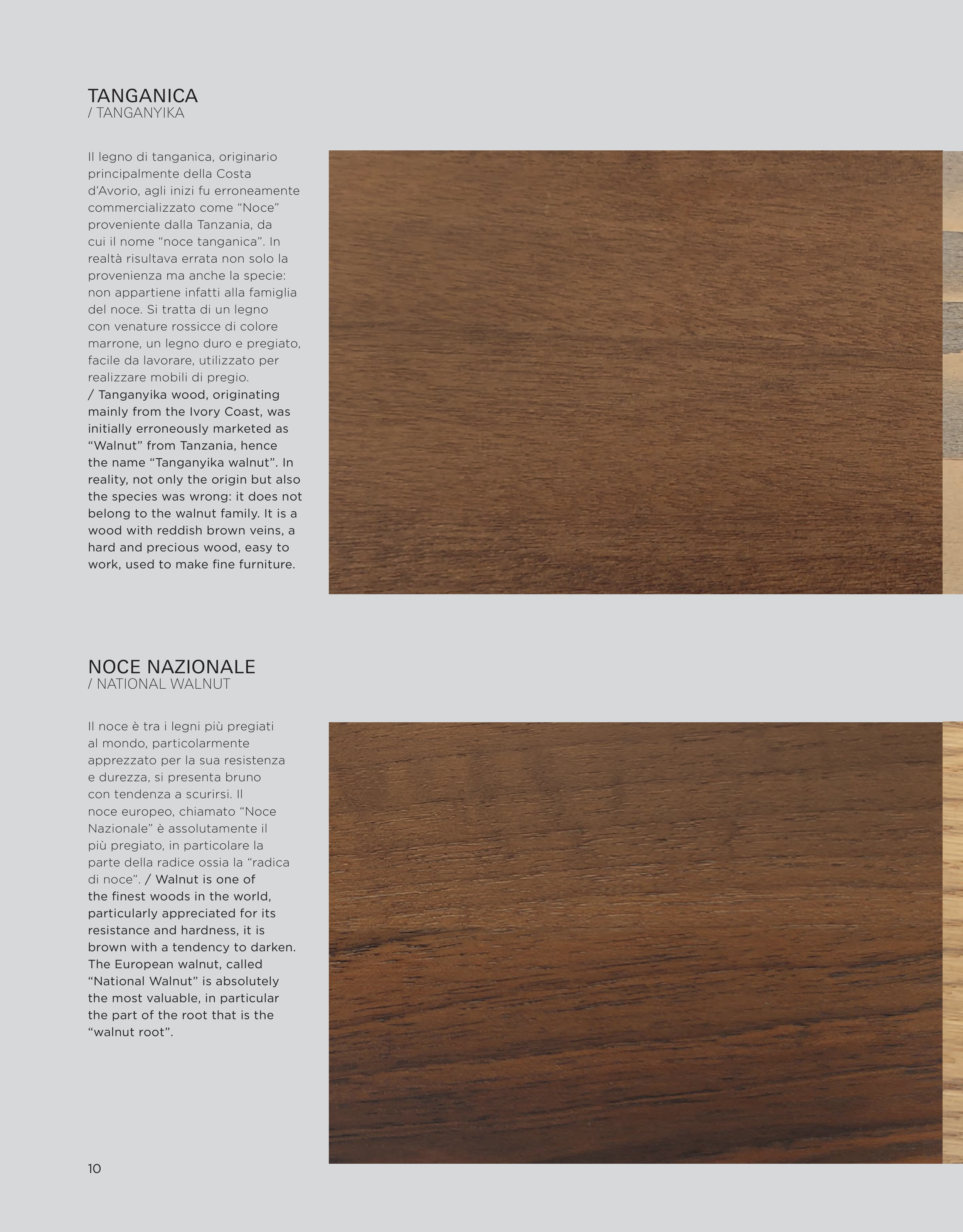
Il legno di tanganica, originario
principalmente della Costa
d’Avorio, agli inizi fu erroneamente
commercializzato come “Noce”
proveniente dalla Tanzania, da
cui il nome “noce tanganica”. In
realtà risultava errata non solo la
provenienza ma anche la specie:
non appartiene infatti alla famiglia
del noce. Si tratta di un legno
con venature rossicce di colore
marrone, un legno duro e pregiato,
facile da lavorare, utilizzato per
realizzare mobili di pregio.
/ Tanganyika wood, originating
mainly from the Ivory Coast, was
initially erroneously marketed as
“Walnut” from Tanzania, hence
the name “Tanganyika walnut”. In
reality, not only the origin but also
the species was wrong: it does not
belong to the walnut family. It is a
wood with reddish brown veins, a
hard and precious wood, easy to
work, used to make fine furniture.
Il noce è tra i legni più pregiati
al mondo, particolarmente
apprezzato per la sua resistenza
e durezza, si presenta bruno
con tendenza a scurirsi. Il
noce europeo, chiamato “Noce
Nazionale” è assolutamente il
più pregiato, in particolare la
parte della radice ossia la “radica
di noce”. / Walnut is one of
the finest woods in the world,
particularly appreciated for its
resistance and hardness, it is
brown with a tendency to darken.
The European walnut, called
“National Walnut” is absolutely
the most valuable, in particular
the part of the root that is the
“walnut root”.
NOCE NAZIONALE
/ NATIONAL WALNUT