K 0642
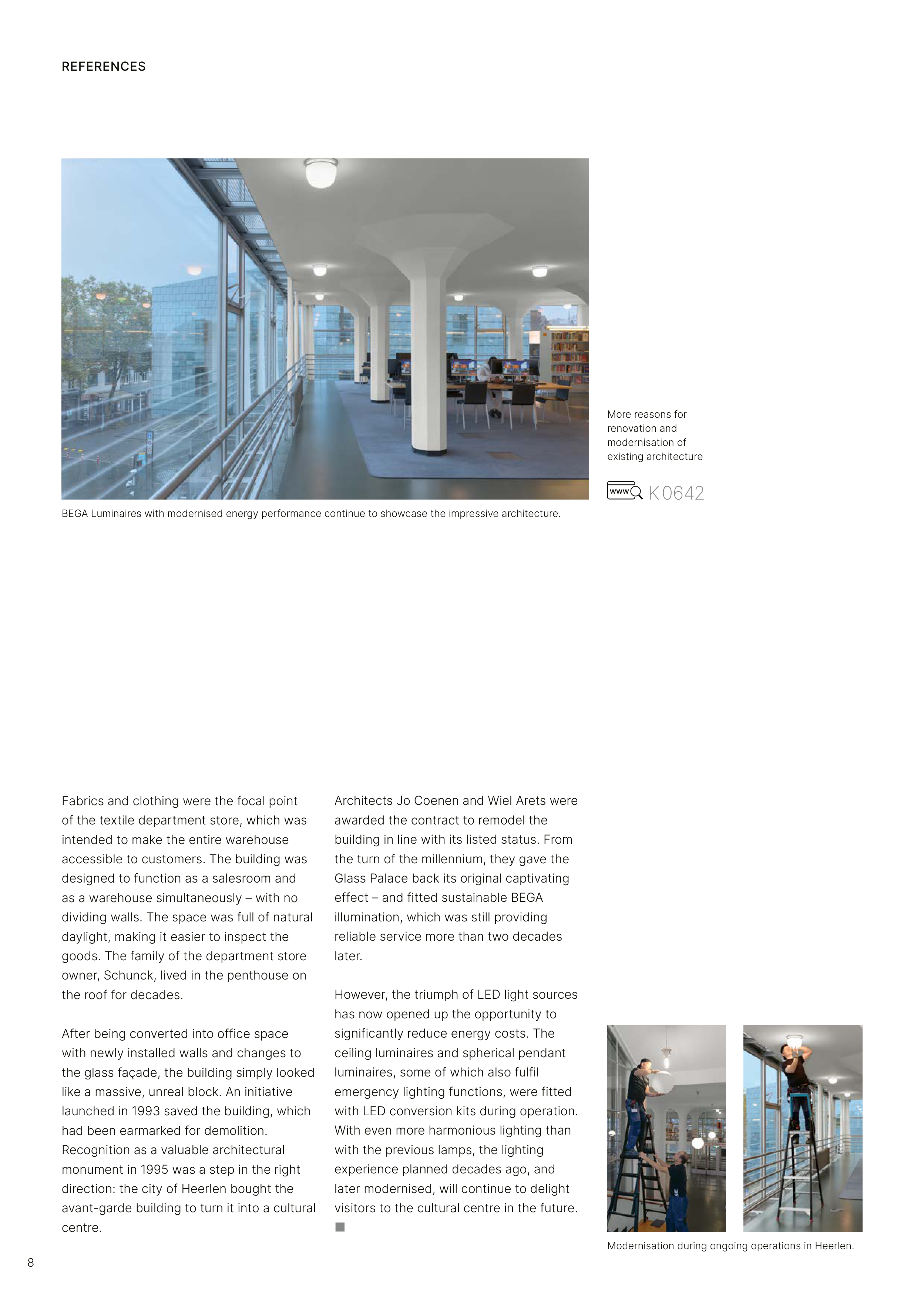
BEGA Luminaires with modernised energy performance continue to showcase the impressive architecture.
More reasons for
renovation and
modernisation of
existing architecture
Modernisation during ongoing operations in Heerlen.
REFERENCES
Fabrics and clothing were the focal point
of the textile department store, which was
intended to make the entire warehouse
accessible to customers. The building was
designed to function as a salesroom and
as a warehouse simultaneously – with no
dividing walls. The space was full of natural
daylight, making it easier to inspect the
goods. The family of the department store
owner, Schunck, lived in the penthouse on
the roof for decades.
After being converted into office space
with newly installed walls and changes to
the glass façade, the building simply looked
like a massive, unreal block. An initiative
launched in 1993 saved the building, which
had been earmarked for demolition.
Recognition as a valuable architectural
monument in 1995 was a step in the right
direction: the city of Heerlen bought the
avant-garde building to turn it into a cultural
centre.
Architects Jo Coenen and Wiel Arets were
awarded the contract to remodel the
building in line with its listed status. From
the turn of the millennium, they gave the
Glass Palace back its original captivating
effect – and fitted sustainable BEGA
illumination, which was still providing
reliable service more than two decades
later.
However, the triumph of LED light sources
has now opened up the opportunity to
significantly reduce energy costs. The
ceiling luminaires and spherical pendant
luminaires, some of which also fulfil
emergency lighting functions, were fitted
with LED conversion kits during operation.
With even more harmonious lighting than
with the previous lamps, the lighting
experience planned decades ago, and
later modernised, will continue to delight
visitors to the cultural centre in the future.
■
8