K 0642
REFERENCES
The luminaire from the year 2000 with its timeless design
language remains – with a new LED conversion kit.
Redesigned BEGA luminaires in front of the historic
façade of the railway station in Hamm.
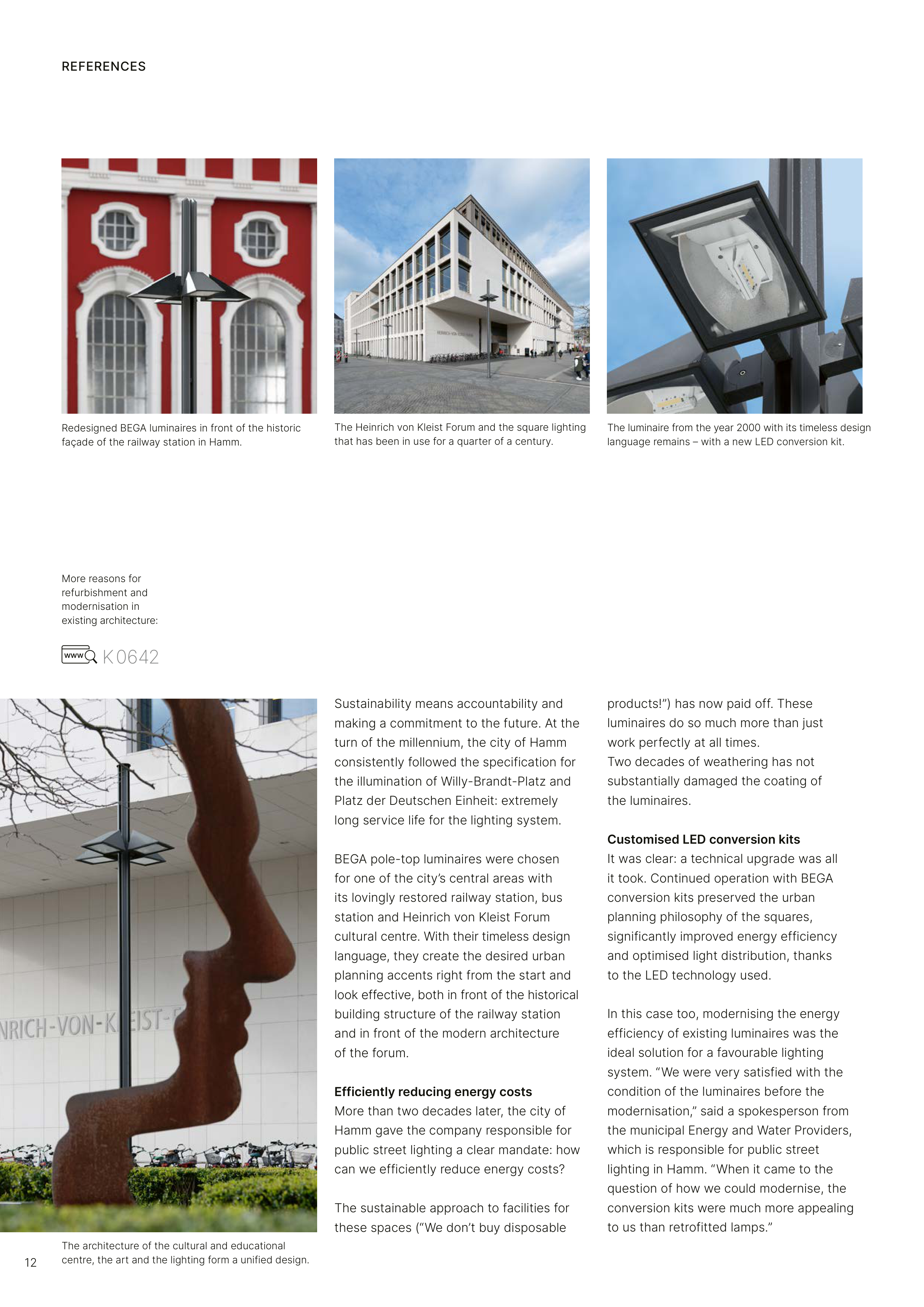
The architecture of the cultural and educational
centre, the art and the lighting form a unified design.
The Heinrich von Kleist Forum and the square lighting
that has been in use for a quarter of a century.
More reasons for
refurbishment and
modernisation in
existing architecture:
Sustainability means accountability and
making a commitment to the future. At the
turn of the millennium, the city of Hamm
consistently followed the specification for
the illumination of Willy-Brandt-Platz and
Platz der Deutschen Einheit: extremely
long service life for the lighting system.
BEGA pole-top luminaires were chosen
for one of the city’s central areas with
its lovingly restored railway station, bus
station and Heinrich von Kleist Forum
cultural centre. With their timeless design
language, they create the desired urban
planning accents right from the start and
look effective, both in front of the historical
building structure of the railway station
and in front of the modern architecture
of the forum.
Efficiently reducing energy costs
More than two decades later, the city of
Hamm gave the company responsible for
public street lighting a clear mandate: how
can we efficiently reduce energy costs?
The sustainable approach to facilities for
these spaces (“We don’t buy disposable
products!”) has now paid off. These
luminaires do so much more than just
work perfectly at all times.
Two decades of weathering has not
substantially damaged the coating of
the luminaires.
Customised LED conversion kits
It was clear: a technical upgrade was all
it took. Continued operation with BEGA
conversion kits preserved the urban
planning philosophy of the squares,
significantly improved energy efficiency
and optimised light distribution, thanks
to the LED technology used.
In this case too, modernising the energy
efficiency of existing luminaires was the
ideal solution for a favourable lighting
system. “We were very satisfied with the
condition of the luminaires before the
modernisation,” said a spokesperson from
the municipal Energy and Water Providers,
which is responsible for public street
lighting in Hamm. “When it came to the
question of how we could modernise, the
conversion kits were much more appealing
to us than retrofitted lamps.”
12