54
55
Lounge
Chapter .01
Outdoor Collection
Caratteristiche
La tecnica utilizzata per la realizzazione del manufatto è denominata colaggio. Il nome
deriva dal gesto di colare all’interno di uno stampo l’argilla liquida, che in termine
tecnico viene chiamata “barbottina”. La realizzazione degli stampi in gesso è affidata
a maestri artigiani in grado di realizzare elementi componibili, che creano una forma
vuota, dentro la quale viene colata la barbottina. Il gesso ha proprietà assorbenti,
pertanto asciuga la barbottina portandola a uno stato solido argilloso, ma solo quando
il manufatto avrà raggiunto la “durezza cuoio” potrà essere estratto dallo stampo. A
questo punto il pezzo è pronto per la prima cottura a 1080° in 24 ore, da questo
processo si ottiene il biscotto. Il biscotto presenta un aspetto bianco e una percentuale
di assorbimento a cui si applica lo smalto con aerografi manuali. Una volta smaltati,
si torna in cottura per 24 ore 980°; la smaltatura artigianale e questo tipo di cottura,
conferiscono ad ogni pezzo un aspetto unico e artigianale, esaltando le sfumature
sempre differenti in ogni elemento.
Sostenibilità
Per la realizzazione di Panarea viene utilizzata una terra bianca, miscelata con Chamotte
al 30% che aumenta la resistenza in pezzi di grandi dimensioni. La chamotte è ottenuta
riciclando pezzi in ceramica già cotti, che per svariati motivi (come ad esempio seconde
scelte, rotture accidentali di pezzi, rotture in cottura) risulterebbero scarti da buttare.
Altra nota importante è l’asciugatura del pezzo, che viene forzata solo con luce solare
o utilizzando il calore disperso durante le fasi di cottura, questo riduce il consumo di
energia elettrica o gas. Per i processi produttivi non vengono utilizzati solventi, ma
tutto viene veicolato con acqua, quest’ultima rientra nei processi produttivi grazie a un
depuratore. L’azienda si impegna a salvaguardare l’ambiente sottoscrivendo contratti di
fornitura di energia da fonti rinnovabili.
Features
The technique used to make the “Panarea” artifact is called “colaggio”. The name is
derived from the act of pouring liquid clay inside a mold, which in technical terms is
called “slip”. The making of plaster molds is entrusted to master craftsmen who can
make modular elements, which create a hollow form, inside which the slip is poured.
The plaster has absorbent properties, so it dries the slip to a solid clay-like state, but
only when the item has reached “leather hardness” can it be taken out of the mold. At
this point the piece is ready for the first firing at 1080° in 24 hours, from this process
we obtain the “biscuit”. The biscuit has a white appearance and absorption rate, here
we can apply the glaze with hand airbrushes. Once enameled, we go back into firing
for 24 hours 980°; The handmade enameling and this type of firing, give each piece
a unique and handcrafted look, enhancing the ever changing shades in each element.
Sustainability
A white earth is used to make Panarea, mixed with 30% Chamotte, which increases
strength in large pieces. Chamotte is obtained by recycling already fired ceramic
pieces, which for a variety of reasons (such as second choices, accidental breakage
of pieces, breakage during firing) would be waste to be thrown away. Another
important note is the drying of the piece, which is forced only with sunlight or by
using waste heat during firing stages; this reduces the consumption of electricity
or gas. For our production processes, no solvents are used, but all are conveyed
with water, the latter being part of the production processes thanks to a purifier.
The company is committed to safeguarding the environment by signing contracts to
supply energy from renewable sources.
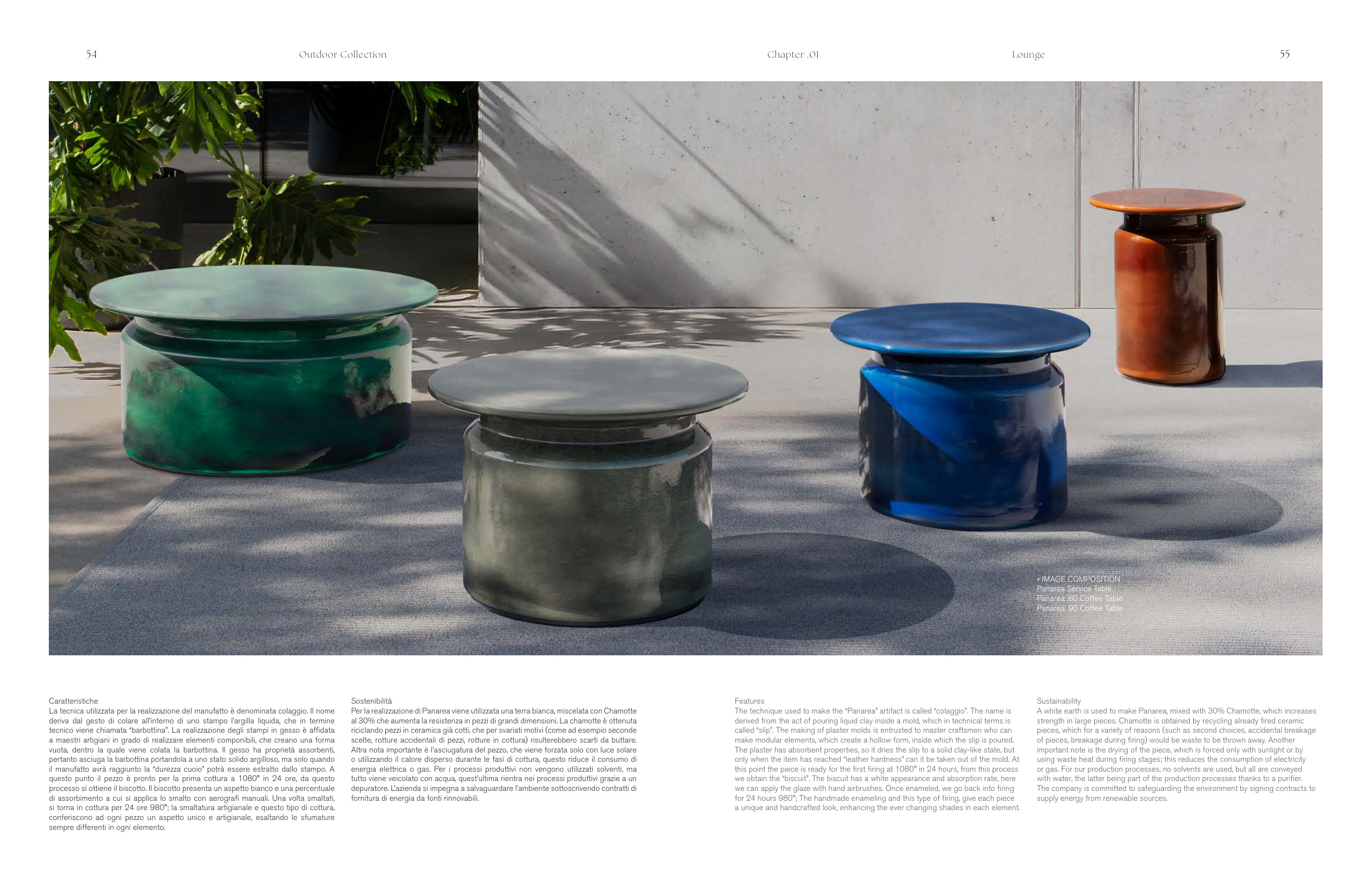
» IMAGE COMPOSITION
Panarea Service Table
Panarea .60 Coffee Table
Panarea .90 Coffee Table