121
120
Designers / Evolution Collection
Designers / Tribute Collection
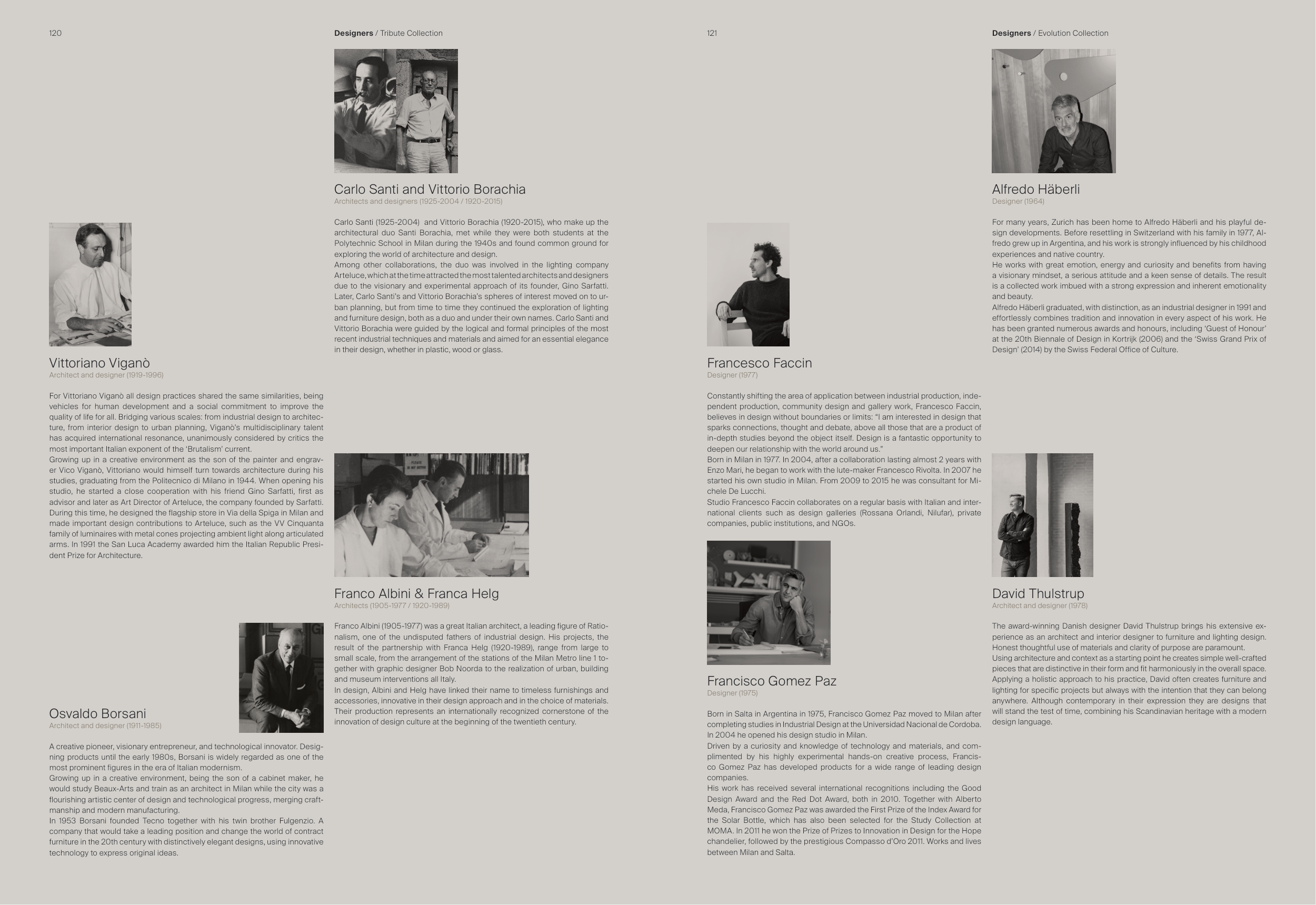
Alfredo Häberli
Designer (1964)
For many years, Zurich has been home to Alfredo Häberli and his playful de-
sign developments. Before resettling in Switzerland with his family in 1977, Al-
fredo grew up in Argentina, and his work is strongly influenced by his childhood
experiences and native country.
He works with great emotion, energy and curiosity and benefits from having
a visionary mindset, a serious attitude and a keen sense of details. The result
is a collected work imbued with a strong expression and inherent emotionality
and beauty.
Alfredo Häberli graduated, with distinction, as an industrial designer in 1991 and
effortlessly combines tradition and innovation in every aspect of his work. He
has been granted numerous awards and honours, including ‘Guest of Honour’
at the 20th Biennale of Design in Kortrijk (2006) and the ‘Swiss Grand Prix of
Design’ (2014) by the Swiss Federal Office of Culture.
Francesco Faccin
Designer (1977)
Constantly shifting the area of application between industrial production, inde-
pendent production, community design and gallery work, Francesco Faccin,
believes in design without boundaries or limits: “I am interested in design that
sparks connections, thought and debate, above all those that are a product of
in-depth studies beyond the object itself. Design is a fantastic opportunity to
deepen our relationship with the world around us.”
Born in Milan in 1977. In 2004, after a collaboration lasting almost 2 years with
Enzo Mari, he began to work with the lute-maker Francesco Rivolta. In 2007 he
started his own studio in Milan. From 2009 to 2015 he was consultant for Mi-
chele De Lucchi.
Studio Francesco Faccin collaborates on a regular basis with Italian and inter-
na tional clients such as design galleries (Rossana Orlandi, Nilufar), private
companies, public institutions, and NGOs.
Francisco Gomez Paz
Designer (1975)
Born in Salta in Argentina in 1975, Francisco Gomez Paz moved to Milan after
completing studies in Industrial Design at the Universidad Nacional de Cordoba.
In 2004 he opened his design studio in Milan.
Driven by a curiosity and knowledge of technology and materials, and com-
plimented by his highly experimental hands-on creative process, Francis-
co Gomez Paz has developed products for a wide range of leading design
companies.
His work has received several international recognitions including the Good
Design Award and the Red Dot Award, both in 2010. Together with Alberto
Meda, Francisco Gomez Paz was awarded the First Prize of the Index Award for
the Solar Bottle, which has also been selected for the Study Collection at
MOMA. In 2011 he won the Prize of Prizes to Innovation in Design for the Hope
chandelier, followed by the prestigious Compasso d’Oro 2011. Works and lives
between Milan and Salta.
David Thulstrup
Architect and designer (1978)
The award-winning Danish designer David Thulstrup brings his extensive ex-
perience as an architect and interior designer to furniture and lighting design.
Honest thoughtful use of materials and clarity of purpose are paramount.
Using architecture and context as a starting point he creates simple well-crafted
pieces that are distinctive in their form and fit harmoniously in the overall space.
Applying a holistic approach to his practice, David often creates furniture and
lighting for specific projects but always with the intention that they can belong
anywhere. Although contemporary in their expression they are designs that
will stand the test of time, combining his Scandinavian heritage with a modern
design language.
Vittoriano Viganò
Architect and designer (1919-1996)
For Vittoriano Viganò all design practices shared the same similarities, being
vehicles for human development and a social commitment to improve the
quality of life for all. Bridging various scales: from industrial design to architec-
ture, from interior design to urban planning, Viganò’s multidisciplinary talent
has acquired international resonance, unanimously considered by critics the
most important Italian exponent of the ‘Brutalism’ current.
Growing up in a creative environment as the son of the painter and engrav-
er Vico Viganò, Vittoriano would himself turn towards architecture during his
studies, graduating from the Politecnico di Milano in 1944. When opening his
studio, he started a close cooperation with his friend Gino Sarfatti, first as
advisor and later as Art Director of Arteluce, the company founded by Sarfatti.
During this time, he designed the flagship store in Via della Spiga in Milan and
made important design contributions to Arteluce, such as the VV Cinquanta
family of luminaires with metal cones projecting ambient light along articulated
arms. In 1991 the San Luca Academy awarded him the Italian Republic Presi-
dent Prize for Architecture.
Carlo Santi and Vittorio Borachia
Architects and designers (1925-2004 / 1920-2015)
Carlo Santi (1925-2004) and Vittorio Borachia (1920-2015), who make up the
architectural duo Santi Borachia, met while they were both students at the
Polytechnic School in Milan during the 1940s and found common ground for
exploring the world of architecture and design.
Among other collaborations, the duo was involved in the lighting company
Arteluce, which at the time attracted the most talented architects and designers
due to the visionary and experimental approach of its founder, Gino Sarfatti.
Later, Carlo Santi’s and Vittorio Borachia’s spheres of interest moved on to ur-
ban planning, but from time to time they continued the exploration of lighting
and furniture design, both as a duo and under their own names. Carlo Santi and
Vittorio Borachia were guided by the logical and formal principles of the most
recent industrial techniques and materials and aimed for an essential elegance
in their design, whether in plastic, wood or glass.
Franco Albini & Franca Helg
Architects (1905-1977 / 1920-1989)
Franco Albini (1905-1977) was a great Italian architect, a leading figure of Ratio-
nalism, one of the undisputed fathers of industrial design. His projects, the
result of the partnership with Franca Helg (1920-1989), range from large to
small scale, from the arrangement of the stations of the Milan Metro line 1 to-
gether with graphic designer Bob Noorda to the realization of urban, building
and museum interventions all Italy.
In design, Albini and Helg have linked their name to timeless furnishings and
accessories, innovative in their design approach and in the choice of materials.
Their production re presents an internationally recognized cornerstone of the
innovation of design culture at the beginning of the twentieth century.
Osvaldo Borsani
Architect and designer (1911-1985)
A creative pioneer, visionary entrepreneur, and technological innovator. Desig-
ning products until the early 1980s, Borsani is widely regarded as one of the
most prominent figures in the era of Italian modernism.
Growing up in a creative environment, being the son of a cabinet maker, he
would study Beaux-Arts and train as an architect in Milan while the city was a
flourishing artistic center of design and technological progress, merging craft-
manship and modern manufacturing.
In 1953 Borsani founded Tecno together with his twin brother Fulgenzio. A
company that would take a leading position and change the world of contract
furniture in the 20th century with distinctively elegant designs, using innovative
technology to express original ideas.